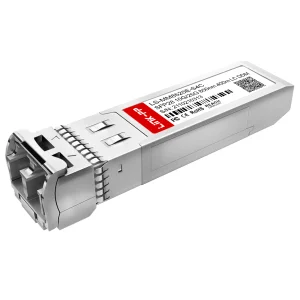
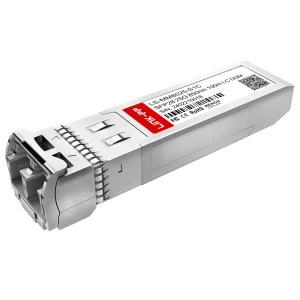
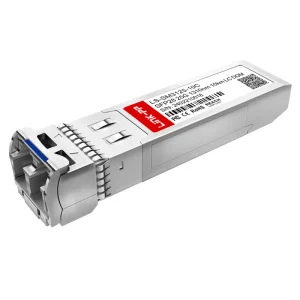
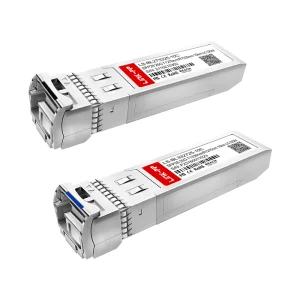
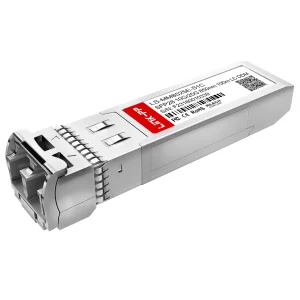
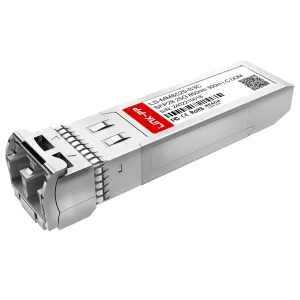
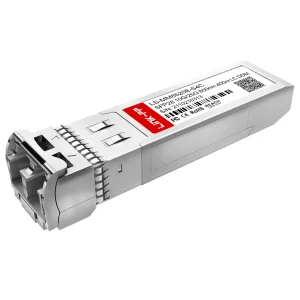
Explore our high-performance compatible modules for enterprise data centers and telecom deployments.
In modern enterprise environments, hyper-scale data centers, and advanced telecommunication infrastructures, bandwidth demand is rising exponentially. The SFP28 (Small Form-factor Pluggable 28) interface is the dominant platform designed for 25Gb/s and 32Gb/s data rates. This technology provides a migration path from 10G SFP+ to higher speeds while avoiding the structural complexity, high power budget, and thermal profiles of larger form factors.
While standard SFP+ operates at a maximum data rate of 10 Gbps (or 16 Gbps for Fibre Channel), SFP28 utilizes the same physical footprint but supports signaling up to 28.05 Gbps per channel. This advancement is made possible by enhanced electrical interfaces (SFI) and upgraded internal optical transmitters (including VCSEL, DFB, and EML lasers). By deploying SFP28, network administrators can match the port density of existing 10G systems while delivering 2.5 times the bandwidth capacity.
Furthermore, 32G SFP28 modules are designed to support 32G Fibre Channel (32GFC) standards (FC-PI-6) running at 28.05 Gbps, providing low latency and high reliability for Storage Area Networks (SANs) globally.
| Transceiver Type | Standard Speed | Modulation Style | Primary Applications |
|---|---|---|---|
| SFP+ | 10G / 16G FC | NRZ | Legacy Enterprise, Metro access |
| SFP28 | 25G / 32G FC | NRZ | 5G Fronthaul, Cloud Data Centers |
| SFP56 | 50G | PAM4 | High-density Data Center aggregation |
| QSFP28 | 100G (4x 25G) | NRZ | Core Switched Networks & Uplinks |
At 25G and 32G rates, SFP28 modules utilize Non-Return-to-Zero (NRZ) modulation. Operating via simple high-and-low voltage states representing binary 1s and 0s, NRZ avoids the signal-to-noise ratio (SNR) penalties and high latency associated with the complex DSPs (Digital Signal Processors) required for PAM4 modulation. This makes SFP28 modules highly reliable, cost-effective, and energy-efficient for latency-sensitive applications like financial trading desks, real-time database replication, and 5G ORAN fronthaul links.
How 25G/32G SFP28 optical modules enable next-generation digital transformation.
Enabling high-density Leaf-Spine architectures. 25G SFP28 downlinks directly from the Spine switches to Top-of-Rack (ToR) server nodes provide high throughput without the cabling bottlenecks of legacy 10G infrastructures.
Providing the high bandwidth needed for eCPRI (Enhanced Common Public Radio Interface) connections. Our industrial temperature range (I-Temp) SFP28 transceivers operate reliably in outdoor environments from -40°C to +85°C.
Supporting high-speed storage area networks. 32G SFP28 provides the throughput needed for flash-based NVMe storage systems to ensure fast backup recovery and minimal database lag times.
Founded in 2016, Novafiber is a professional optical transceiver manufacturer specializing in high-performance fiber optic communication solutions for global data centers, telecom operators, and enterprise networking applications.
Operating with a modern production facility, Novafiber integrates a strong trade background in international OEM/ODM manufacturing. With over 9 years of industry experience and 7 years of export experience, the company delivers reliable optical hardware to markets in North America, Europe, Southeast Asia, and the Middle East.




Quality and reliability are key for critical telecommunication links. Novafiber maintains quality control protocols to ensure compatibility and field performance.
Our quality assurance workflow employs 65 quality inspection personnel monitoring every stage from PCBA reflow to final packaging. Each transceiver module undergoes testing designed to meet international standards:
Novafiber transceivers comply with global import, environmental, and laser safety directives. This support allows project integrators to deploy our modules in municipal, enterprise, and cloud environments without regulatory hurdles.
| Compliance Body | Standard Met | Scope |
|---|---|---|
| CE Mark / FCC | EN 55032 / Part 15 Class B | Electromagnetic Interference & Compatibility |
| RoHS / REACH | 2011/65/EU Directive | Restriction of Hazardous Materials |
| Laser Safety | FDA CDRH Class 1 / IEC 60825-1 | Eye safety compliance under normal use |
The networking ecosystem continues to evolve. While 25G and 32G SFP28 remain a key standard for ToR links, migration to higher speeds is ongoing. Our roadmap is designed to support this evolution:
By integrating optics onto silicon chips, silicon photonics reduces component counts, improves thermal efficiency, and lowers cost-per-bit for long-reach networks.
Moving from 25G to 50G links is simplified using SFP56 modules. Utilizing PAM4 modulation, these modules double the data throughput while maintaining SFP form factor compatibility.
Reducing energy consumption is a key design goal. Our current-generation 25G transceivers feature low power dissipation (typically under 1.0 Watt for short reach), helping data center operators reduce power and cooling overheads.
Answers to common integration, compatibility, and implementation questions.
No, in most instances. While SFP28 and SFP+ share the same physical dimensions, standard 10G SFP+ ports lack the electrical design and internal clocking support required to interface with a 25G SFP28 transceiver. However, SFP28 ports on a switch are backward compatible, allowing you to use a 10G SFP+ module in a 25G SFP28 port, provided the switch port is configured for 10G operation.
The SFP-25G-SR-S operates at 25 Gbps over multimode fiber with a transmission range of up to 100 meters (OM4). The dual-rate SFP-10/25G-CSR-S operates at both 10G and 25G speeds and supports extended link reaches of up to 400 meters on OM4 multimode fiber, offering flexibility for varied infrastructure setups.
Yes. Under IEEE 802.3by specifications, SFP28 links (especially for distances greater than 10 meters) use FEC (either FC-FEC or RS-FEC) to manage bit error rates (BER). It is important that both the host switch port and the module have matching FEC configurations (either enabled or disabled) to establish a link.
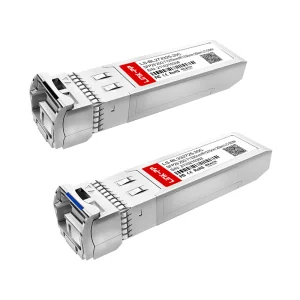
Bidirectional (BiDi) transceivers transmit and receive data on a single optical fiber by using two different wavelengths (for example, 1270nm-TX/1310nm-RX and 1310nm-TX/1270nm-RX). These modules must be deployed in pairs to avoid signal interference on the single core.
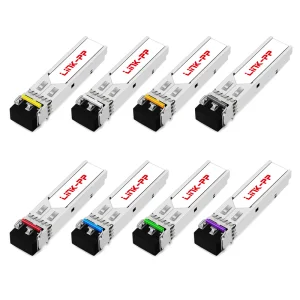
Explore CWDM, DWDM, LWDM, and customized dual-rate transceivers for long-haul networks.
 Novafiber